
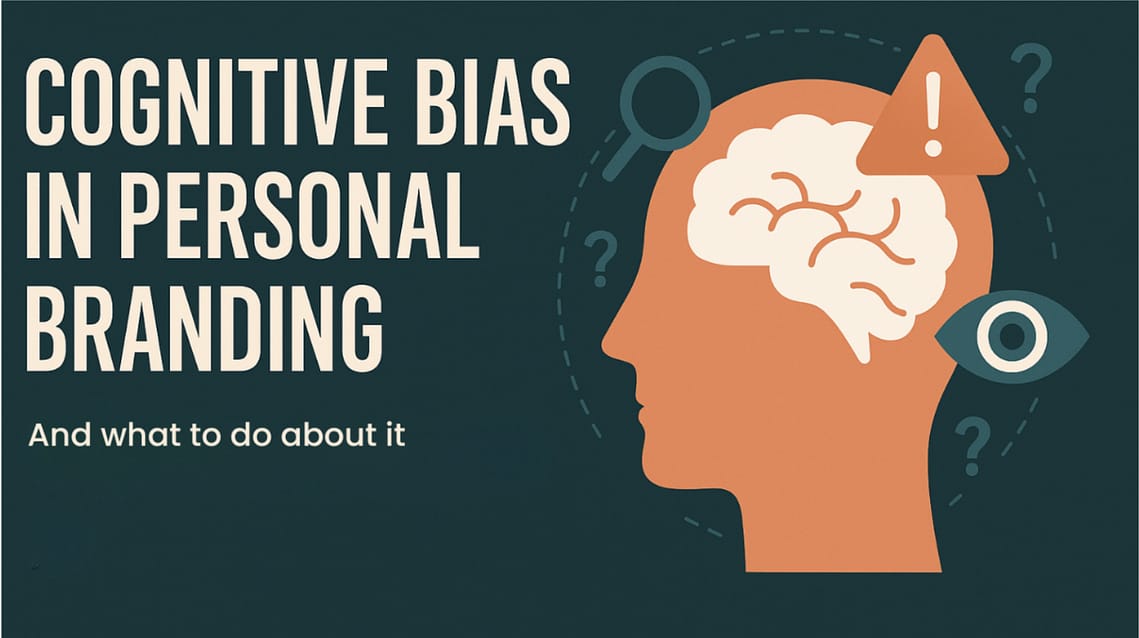
Does Cognitive Bias Affect How You Build a Personal Brand? Absolutely.
Most people think personal branding is all about strategy, clarity, and consistency. But beneath all of that lies the human mind—full of shortcuts, blind spots, and biases that quietly shape how we show up online.
Working closely with CXOs, Founders, and Leaders over the years, one insight stands out:
Cognitive biases influence your visibility far more than the algorithm ever will.
Here are the four most common biases that show up during the personal branding journey—plus strategies to overcome them.
1. The Spotlight Effect — “Everyone is watching me.”
Research by Gilovich & Savitsky shows we massively overestimate how much others notice our mistakes, flaws, or inconsistencies.
This is why many professionals delay posting for months—overthinking every word and fearing judgment.
How to avoid it:
- Accept reality: People are not analyzing you as much as you think—they’re busy thinking about themselves.
- Shift focus: Prioritize the value you provide, not the perfection of your delivery.
- Normalize visibility: Posting consistently reduces anxiety and builds comfort.
2. Confirmation Bias — “I only post what reinforces my self-image.”
We unconsciously filter content based on what feels “safe,” avoiding vulnerability, failure, or personal growth stories. This results in a brand that looks polished—but sterile and forgettable.
How to avoid it:
- Self-audit: Ask yourself, “What am I avoiding sharing—and why?”
- External review: A mentor or strategist can challenge your blind spots.
- Content mix: Blend expertise with lived experiences, vulnerability, and lessons learned.
3. Anchoring Bias — “My early performance defines my capability.”
If your first few posts don’t perform well, your mind anchors to that outcome: “Maybe I’m not cut out for LinkedIn.” Research by Tversky & Kahneman shows how strongly first impressions influence decisions—even when new data says otherwise.
How to avoid it:
- Treat the first 20 posts as experiments—not judgments.
- Study patterns, not individual numbers.
- Prioritize volume: Consistency unlocks meaningful insights.
4. The Dunning–Kruger Effect — “I know enough / I don’t know enough.”
Some leaders underestimate their expertise (imposter syndrome). Others overestimate it. Both limit growth.
How to avoid it:
- Ask the golden question: “What do I know deeply—and what do I need to learn more about?”
- Diversify content: Insights, learnings, reflections, and questions.
The Strategy: Build a Bias-Aware Personal Brand
Overcoming these biases requires operational clarity—not just inspiration.
1. Seek External Perspectives
A strategist or mentor helps reveal what you cannot see. They are the mirror to your blind spots.
2. Design a Repeatable Framework
Your content calendar should run on systems, not your mood. Frameworks reduce emotionally driven hesitation.
3. Let Data Guide Progress, Not Identity
Analytics help you optimize—not define your self-worth. Detach your ego from metrics.
4. Do Monthly “Bias Audits”
- What did I hesitate to post?
- What feedback did I ignore?
- What patterns did I overinterpret?
Conclusion
You don’t build a personal brand merely by writing. You build it by thinking clearly, managing biases, and reducing the psychological distortions that hold you back.
A strong personal brand is not just a communication strategy—
It’s a mindset strategy.